Showing posts with label recipes. Show all posts

Sunday, March 25, 2012

Review: Free Online Weight Lost Center - Cinch Club

Cinch Club - Free Online Weight Loss Center

Of the two online weight loss centers which Shaklee provides, the Cinchclub.com is the free one. And what we'll review today.

It's remarkably easy to sign up for. (Did I mention it's free?!?) And behind the login as a real wealth of data.
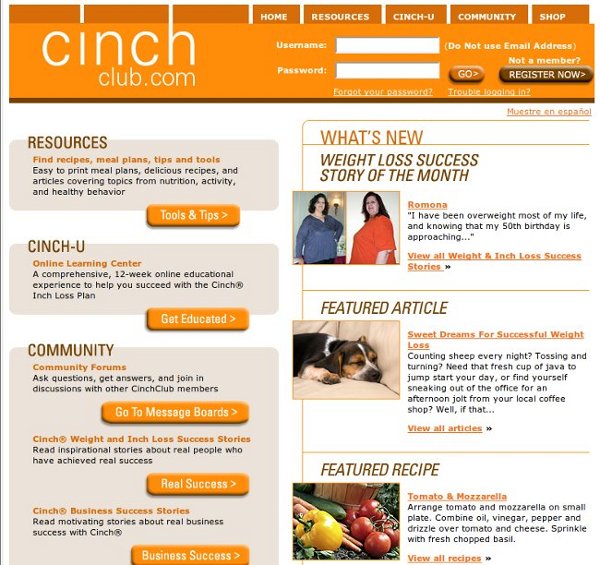
Cinch Club Free Online Weight Loss Center

And we could spend all day just talking about the points that are available here. But I haven't gotten through all of them yet, myself.

Of course there the forums, where you can interact with like-minded people. But the recipes are great - to both get your weight and size down to where you want it, and also to train yourself in low-calorie-but-great-tasting ways to keep it there. Well over 60 different ones, many of them weight loss shake and smoothie recipes. Plus, they're all PDF's for easy download and printing. I hope to share many of these with you in the coming months.

The articles is another high point, however. Just that one in the image above is something else. Did you know that if you eat just before sleeping, your body tries to burn it off like you are awake? This could be the reason for all those wild dreams. And then, being tired the next day, you're wanting to eat more as your metabolism is lousy. Perfect diet-buster. Lesson? Keep to a schedule which has the last food at least 3 hours before sleeping. Again, I hope to excerpt these as I review this site later.

A next section to investigate (and there are so many options, a great site overall) is their Resources section - which is linked at the top of every page.
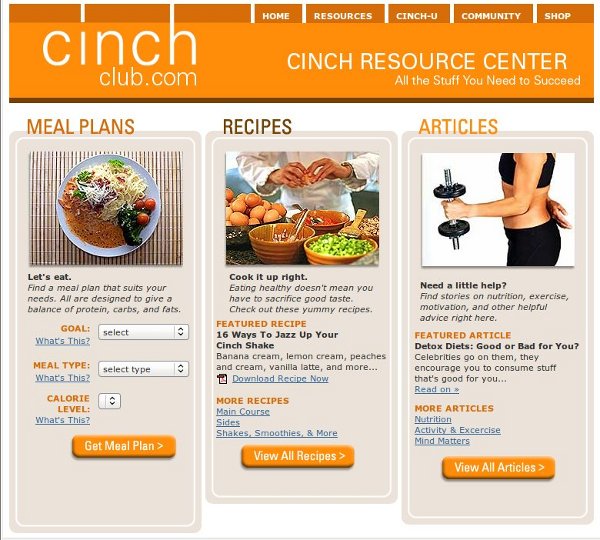
Cinch Club Online Weight Loss Center - Resources

A really useful link is that "Meal Plans" section above. You select your goal (lose weight or maintain weight), then what type of meal (regular, no dairy, no red meat, lacto-ovo-vegetarian) and then calorie level (1200, 1500, 1800, or 2100). When you click on Get Meal Plan, then a pdf comes up, ready to download.

Recipes and articles are also linked here, only you get right to the "View All" page. 

Up at the top, you can see a "Cinch-U", which is 12 weeks worth of courses that you can take to learn all about dieting and what you need to know to succeed. The first week is open to anyone (who doesn't want to sign up free) and tells you simply how the Cinch Inch Loss diet plan works, plus why you should exercise and how to create SMART goals. And there's a simple test after each one which tracks your progress.

Again, more to tell you about later as we go through this together. (I'll stick to the diet if you keep reading this blog...)

Over further, you'll see the forum. I was intersted to see that this is a pretty active forum, with people signing up every few days. And there are many posts coming in. I see several for this month and a couple just today - as I write this. What's great about the forum is that you can help others and help yourself. Looking through the posts, I see that people are keeping this posting in as a way to hold themselves accountable.

One thing I'd suggest you check out is their Expert Q&A under the Community Section. It's huge.

If that's the only reason for signing up to this free site, it would be enough. All the rest is gravy.

Well, I'd have to give this site an "A" rating. Everything is easy to find and all the questions I can think of right off have been answered (or made easily available.)

I'd suggest you check it out, too - regardless of what diet you are on. Or if you're dieting at all. Might give you a reason to start - and definitely will give you a reason to keep going.

Monday, March 12, 2012

Finding the Best Diet for Weight Loss

How to find the Best Weight Loss Diet Program

In working to determine the best weight loss diet program, you can quickly see that the essentials to diets are just a few.

Any and all weight can be controlled by just 2 things - calories input and calories burned.The old saw is that you "eat less, exercise more, or both". Consume fewer calories as you eat and burn more than you used to.

And that's fine to state, but harder to keep going as a program. Because there are 3 factors which control your success on any diet: physical, mental, and social. 

Physical - your body is used to certain quantities and bulk. Some people are used to simply filling their stomach area when they eat. While this was fine for teen-agers, once we hit middle age or later, our metabolism slows down and so we start storing more in fat - which is where all excess food is stored. As well, fast food restaurants know that people get addicted to fat, salt, and sugar. And a physical addiction is where the body simply adjusts to living off a certain regular amount of these substances, and won't "feel good" if these aren't present. The problem is that fast food is mostly "empty" calories - meaning that you don't get a lot of useful vitamins, minerals, or other nutrients. You can feel "full" but still not have the nutrition your body needs, so you have to eat some more - more than you should need. When you cut down the amount or type of foods you eat, then there is some pushback from the body to get some more.

Mental - as teenagers can eat anything they want, and our middle-class lifestyle (as well as the growing numbers of convenient fast food outlets) allow us to eat anywhere and any type of food we might want. Most people don't cook their own food from scratch - so we aren't used to selecting and judging amounts. We also aren't usually taught how many calories are in whatever portions we are being served. And additions also have their mental counter-part - it's giving control of that part of your life to someone or something else. Most mental "noise" is composed of habits, ways to figure out how to survive better. And habits can be changed in about 30 days of practice.

Social - these various addictions and habits are reinforced by what groups and people you have around you. You will usually pick your friends to support your own world view and beliefs. And overweight people are usually surrounded by - yes, overweight people. So this makes it harder to change, when the world around you is resisting change. So the best programs have support groups that are sponsored at either a corporate or grass-roots level, or by a combination of both. The point is to get people around you who think and act like you do, so you can change your old habits and not go back.

A successful diet system will take all five of these elements into account:

  • You'll get enough calories to sustain your health. You'll also have enough energy to do whatever you want. 

  • You'll be exercising more, but in a fashion that you can get this into your lifestyle simply. 

  • The food you get will be enough to keep you going, and not hungry during the day.

  • There will be an education program which will teach you what your portion sizes are and which foods will just be stored as fat instead of being consumed.

  • There will be a support group so you can stay on your program instead of distracted or negated from doing it.

If you take these 5 points, you'll be able to find the best weight loss diet program.

In a later article, I intend to compare the various weight loss diet programs to help you select the best one for your situation. Of course, I already have a good idea, but I frequently surprise myself as I do the research.

More information about the Cinch Inch-Loss Diet Plan can be found as linked below:


Learn about the real science behind the Cinch Diet Plan | Introductory sampler now available.

Related Weight-Loss Articles:

Sunday, March 11, 2012

Obesity in America - Facts

Obesity Treatment in America - Facts and Solutions

We are unfortunately reaching the point of no-return with Obesity in America. In 1980, 35% of Americans were overweight to obese. By 2010, more than 65% of Americans range from overweight to obese. (Source: Behavorial Risk Factor Survelliance System, CDC).

And while the increasing percentage of adults has leveled off, childhood obesity continues to soar as an epidemic. It is suggested that for the first time in our country's history, this next generateion will live shorter lives than their parents.

Obesity is a key contributor to other illnesses, such as:

  • Stroke

  • Dyslipidemia

  • Hypertension

  • Osteoarthritis

  • Type 2 Diabetes

  • Gallbladder Disease

  • Coronary Heart Disease

  • Sleep Apnea and Respiratory Problems

  • Some Cancers (endometrial, breast, and colon)

And according to the American Journal of Epidemiology (2011), 1 out of 2 obese people will die prematurely due to complications associated with their weight.

The Wikipedia has devoted an article entirely to the Epidemiology of obesity:

"The United States has the highest obesity rates in the developed world.[2] This is a long-standing phenomenon: already by 1962, 45% of adult Americans were overweight, and 13% of adult Americans were obese;[34] these numbers were already higher than obesity rates observed in most developed countries as late as 2001-02. From 1980 to 2002, obesity rates have doubled, reaching the current rate of 33% of the adult population.[35] As of 2007, 33% of men and 36% of women are obese.[36] Rates of obesity vary between social groups, with minorities and low-income individuals more likely to be overweight. The rates are as high as 50% among African American women.[37] Geography is a major factor. The American South has been described alternatively as "Stroke belt", "Obesity belt", or "Diabetes belt", to reflect the fact that all residents of the region have high incidences of these three conditions, compared to people of the same race/ethnicity elsewhere in the country.[38] The lowest obesity rates of major racial/ethnic groups across 50 states are thought to be among non-Hispanic white residents of Colorado and Hawaii, at around 16%. However, these numbers are based on self-reported height and weight data and likely to be underestimated (the bias is so large that, for example, estimates of obesity that rely on self-reported data arrive at the rate of 22% among non-Hispanic white females, whereas studies that involve direct measurement show that the rate is closer to 34%.) [39]

The prevalence of class III obesity (BMI ≥40) has increased the most dramatically, from 1.3% in the late 1970s,[40] to 2.9% in 1988-94, to 4.7% in 2000,[41] to 5.7% in 2008. Among African American women, its prevalence is estimated to be as high as 14%.[42]

The overall rate of obesity began to plateau in the '00s, but severe obesity and obesity in children continued to rise.[36] In January 2010, a study published in the Journal of the American Medical Association found that the obesity rate for American women has remained constant over the last decade, with only small rises amongst men and children.[43]

Obesity is one of the leading health issues in US society, resulting in about 300,000 deaths per year in the United States.[44] About 65 percent of Americans are now considered either overweight or obese.[45] According to National Health and Nutrition Examination Study collected between 1970s and 2004, overweight and obesity prevalence have increased steadily among all groups of Americans over the past three decades.[46][47]"

Solution to this seems simple: lose weight. But that isn't necessarily true of all diets. They can make you lose the wrong type of weight.

If you're like 65% of Americans, overweight or obese, now is the time to achieve a healthy weight that's right for you. And the good news is that you don't have to lose a lot of weight to reduce your risk for disease and improve your health. A modest weight loss of 5-10% in body weight (10 lbs. for example) can significantly reduce your risk of developing type 2 diabetes and coronary heart disease and can also help lower blood pressure and cholesterol levels. Achieving a healthy weight starts by watching your caloric intake and the best way is to make modest decreases in the amount of food you eat each day combined with a significant boost in your level of physical activity. Commit to a comprehensive weight management program, designed to help your body preserve lean muscle which is essential to weight management success. Preserving lean muscle while you lose weight from fat helps preserve your metabolic rate or your ability to burn calories.

The only weight loss or management program I've found to preserve lean muscle mass while reducing fat is the Cinch Inch Loss Diet from Shaklee.  You may have seen my other articles on this point, which go into much more detail. The short and long of it is that Shaklee scientists have found from their studies with sports nutrition that the amino acid Leucine is vital to ensuring the body preserves muscle and burns fat. To do otherwise, lowers your metabolism and puts you on a yo-yo cycle of gaining and losing weight, but really only losing muscle volume. And feeling more and more lousy, more and more of the time. Muscles are needed to keep your metabolism up, and feeling your best.

If you have questions about the Cinch Inch Loss Diet, please check out the Cinch Frequently Asked Quesions.

More information about the Cinch Inch-Loss Diet Plan can be found as linked below:


Learn about the real science behind the Cinch Diet Plan | Introductory sampler now available.

Related Weight-Loss Articles: