
Showing posts with label angus. Show all posts

Monday, February 10, 2014

How a Belted Galloway Bull Mean More Grass Fed Beef Per Acre?

Bull Choice Means Higher Efficiency on Pastures
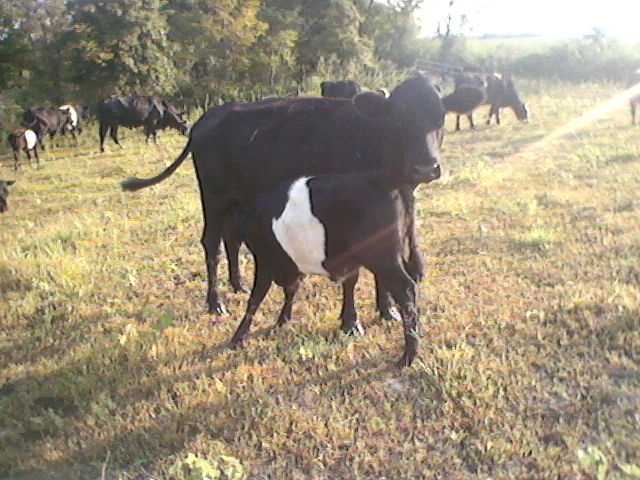
Galloway-mix beef cattle are more efficient at finishing on grass pastures.Got this newsletter from Kit Pharo, which sums up some choices we made in a bull (not one of his) a couple of years ago:

"If your ranch can support 100 head of 1400-pound cows, it should be able to support 120 head of 1100-pound cows – on the exact same inputs.   That’s 20% more cows producing 20% more calves. 

Because smaller cows can wean a higher percentage of their own body weight than bigger cows, they will always produce MORE TOTAL POUNDS on the EXACT SAME INPUTS.   I have NEVER EVER found a commercial ranch situation where bigger cows were more profitable than smaller cows."

We went with a Belted Galloway and that turned out to drop our average steer weights from about 900-1000 lbs down to around 700. Of course, with the prices going up, we were able to keep our prices the same and we were still at auction levels. It didn't please some regulars who got a lot less this year, but when I showed them the numbers, they were still grateful to get that quality.

It does mean that we will be getting a scale to ensure we are running fair to everyone.

Even with the drought this year, we haven't been running shy on grass. It's mid August now and I've still got another couple of pastures to get through the first time before I start heading back through some of the others.

So we'll be able to actually put more head on (save back more heifers) once the weather evens out. These will be mixed Galloway-Angus, so will be a smaller frame.

However, the advantage of Galloway is that they eat a wider variety of forage - and so have tended to teach my older Angus a few things about what they used to simply leave as "weeds".  We mostly graze from one side of the paddock to the other now, instead of from "dessert to spinach" as is common.

And our beeves are much more mild-tempered, another factor of Galloways. (Had to herd some of my neighbor's all-black Angus steers today - and was reminded of how much I was missing in anxious running to corral them.)

With a 700lb beef, you are getting around 70lbs. in the freezer. And this is more doable for most people. So I think we are winning all the way around.

If I could get the conventional system to quit raising beef prices in general, my customers would be happier, but to get beef at wholesale prices is still a big bargain, regardless.

And that's what we're here for - to help people improve their quality of life.
Enhanced by Zemanta

Friday, October 5, 2012

How to Find Replacement Heifers for your Herd - Drought Recovery

Replacement Heifers and Bulls

Replacement heifers and bulls available for re-stocking herds.We raise replacement heifers and bulls on request for farmers and ranchers wanting to either diversify their herd genetics or replace with smaller frame size to improve profitability.

These are being made available at this time as we know a lot of people have had to downsize their herds due to recent drought. 

We have recently just replaced all our older stock from our own saved-back heifers, so we now want to make our particular line available to others.

You can enjoy time-saving, low-maintenence farming and ranching with these healthy cattle.

The original stock was a combination of Black-Whiteface and Brangus/Angus-cross cows. These were and are bred to a registerd Galloway Bull from Sapp Farms in Columbia MO, named "Gene Autry".

Galloway bulls have no problem mounting full-size cows - our calves are proof of this.

These calves are composite, not registered or purebred. They can have more or less of Brangus or Hereford in their lineage. Right now, we can trace these back 3-4 generations and tell you general attibutes of any given calf. It's the hybrid vigor which we pay attention to - this gives us longer-lived and healthier cows and calves. More years producing more calves, with low cost in between. Less worries, more profit.

The offspring of this mix has a low birth weight, fast-gaining calf which tends to be a medium-frame size. The reason we did this is to import the qualities of a more tender beef and the Galloway ability to eat a wider variety of forage.  Galloways also put on an extra heavy coat in winter, so they do not add extra back fat. This makes for lean beef, but also gives a higher carcass weight with less loss on the cutting room floor. And that means more profit for everyone.

Our own observation of first and 2nd generation shows that this has been the outcome after some years of raising these.

Hybrid vigor with smaller frame size means more profits for more years.Smaller breeds have been found to be more efficient in grazing than the heavier weights, as you can get  more pounds of beef produced per acre, since they have proportionately longer backs and shorter legs than conventional Angus.

As well, our beef are grazed intensively in paddocks, so they quickly learn to eat everything available. We've found that our "weed" problem after these cattle have been through a paddock is remarkably less or non-existant, depending how intensively we stock them.

That added benefit (not having to clip or "brush-hog"  pastures) is another time and money savings.

Galloways are also remarkably docile and easy to herd. There is none of this "wildness" or spook-prone aspect more common these days with dairy bulls and conventional Angus.  All our calves are worked with daily to get them used to humans.  As their dams have been hand-raised as well, they quickly become adjusted to being checked at close range without shying easily. Our bull calves have not become "onery" or aggressive.

Easy working means less upsets for you, more weight gain for your cattle.

Our beef are all grass fed, so we are missing comparatives for raising them up in a feedlot setting.

The varying patterns assist in the situation of missing ear tags (which can be problematic with all-black cows.) As well, they are very pretty to look at and give remarks by any who come to see them. We tag all our calves when they are weaned, and give a complete set of shots against the common illnesses (whatever our vet recommends).

Low birth-weight, fast growing calfs with distinctive markings saves time and improves profits.They are not given growth hormones or feed additives. They are given plenty of grass, water, and sunshine (as well as shade). We keep salt and minerals available year-round, as well as protein tubs in winter to supplement hay.

Our heifers are kept to 14 months. Please contact us before the beginning of June, which is when I have to ship these. Unless specified and contracted for, they will not be bred. Obviously, the typical care with any first-time heifer must be taken.

Bulls will need special arrangements, as I generally make them into steers on weaning. However, this is under consideration if there is a demand for such.

(Last year, I had a particularly good bull calf which is making a remarkable steer, but would have been choice genetics otherwise. And this particular year, I have a set of twin bull calves I am saving back just for that line of genes. If contacted soon enough, I might be able to match with heifers who have twins in their history.)

There's a joy and satisfaction to raising quality beef you can be proud of - and fatten your bottom line as they fatten on grass.

Again, we want to make this available to the industry and plan to keep our prices competitive with the state auction average so that herd restocking can be made affordable.

Contact us for more information.


Monday, March 8, 2010

New Calf - New Breed?


Well, this little cuss was born yesterday and was up and kicking his heels within hours. Quite a beauty.

He's a cross between a Belted Galloway (Beltie) bull and a white-faced Angus cow. That's how he's gotten his darling Panda looks.

The advantage of the Beltie/Angus cross is that you get the faster weight-gain of the Angus with the improved forage efficiency of the Beltie - who is rumored to eat almost anything out there. We've had one other last year, a heifer, who is already known affectionately as "Little Goat".

Combined with our shift to managed grazing, ultimately to a "mob stocking" level, we will be able to produce an improved efficiency through our crossbreeding and forage management.

I'm working on a whitepaper about this subject, so should have more information for you shortly. And I have to get a video of this new little one for YouTube...

But our lives are already enriched.
Posted by Picasa