Showing posts with label belted galloway. Show all posts

Wednesday, December 2, 2015

How to Select Replacement Heifers

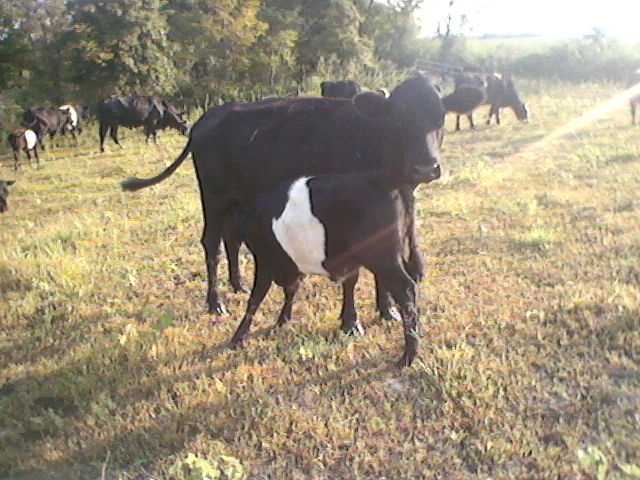
Beltie-Angus cross stock from Worstell Farms make great replacement heifers.
This is "Sidesaddle" and her heifer calf from earlier this year. Note the good body condition just a week or so after birthing.
(Found this article by veteran rancher and herdquitter Kit Pharo. Thought you might be able to use it.)

Q and A –
By Kit Pharo

Question: Hi Kit, I was wondering how you select replacement heifers from your herd – or do you have some suggestions on how I should select my heifers?” 
Answer:
Enough articles have been written about the proper way to select and develop replacement heifers to fill a large barn.   Guess what?   It’s not really that complicated.   I don’t know why everyone is so determined to complicate simple matters, but they are.

Weaned heifer calves that have been saved for replacement females will not generate any income for two years.   Therefore, ranchers simply cannot afford to invest much money into their development.   Rather than place them in a high-input, artificial environment and haul expensive feed to them, we need to treat them like the cows we hope they will become.   They need to be out foraging for themselves, with minimum inputs.   If a heifer can’t do this, she probably won’t make an efficient and profitable momma cow.

We suggest you retain nearly all of your heifer calves, rough them through the winter and expose them to a bull for a very short period of time.   This system will allow only your most efficient and early maturing heifers to advance into the cowherd.   Why not let the environment sort out your best replacement heifers?   The remaining heifers can be treated as stockers and sold for a profit.

If you breed your heifers to calve when God intended them to calve, you will be amazed at the high number that will conceive during the first 21 days of the breeding season.   Even heifers that were cheated during the winter months are able to catch up with two to three months of good green grass prior to breeding.   If you end up with more bred heifers than you need, you can sell the extras for a profit.   I suggest you let the buyer select from the herd, because he won’t be able to pick out the best ones any better than you.

So what about selection?   You and I are NOT capable of doing as good a job of selecting replacement heifers as the environment can do.   Form will follow function if we stay out of the way.   However, there are a few things that deserve to be looked at.   Here is my list.

1.     Get rid of the outliers, dinks and freaks.   In many herds, this includes some of the tallest heifers.
2.     Watch disposition.   Cull those with flighty and/or nervous dispositions.
3.     Look at feet and leg structure.   Any problems you see now will only get worse.
4.     Select for heifers that shed the quickest.   Cull heifers with dull, dead looking hair.   This is an excellent indicator of health and adaptability.
5.     If you still think you need to do some more culling and/or selecting, you can look at conformation.   I prefer heifers that are shorter, thicker and easier fleshing.   The more pounds per inch of height, the better.   I cull heifers that look long, because that means they are gutless.   Contrary to what show ring judges tell us, body length is an optical illusion.   I also cull heifers that are coarse and/or masculine in appearance.

Keep the pressure on…   We run our replacement heifers with our mature cows.   They receive no special care.   We calve our heifers out on open range with the cowherd.   This continues to force the inefficient and unadapted females out of our program.   The sooner you identify the heifers that can’t make it, the better.   Every replacement female should have to earn a place in the cowherd.

Tuesday, April 15, 2014

Why our prices haven't gone up like everyone else.

Because we don't feed corn - and our costs haven't (really) gone up.

We don't raise the beef just to increase our profit margins.
 (photocredit: LandingMemo)

The point is to provide real value.

And that's not just limited to some of the best-tasting beef you can find for wholesale prices. It's treating people like family, or better. (We're working constantly to improve on that point.)

We're looking to get regular clients. That's more valuable than getting everything sold from year to year. Our prices are decent enough we don't have to rely on the auctions.

At this point, we have another value to add - prices lower than average, and higher quality than any supermarket. Plus you know where it comes from and you can visit to find out exactly how we raise them.

Sure, I don't get all the pictures, and stories, and videos up for you. Running a cattle farm keeps you more than busy. We're transitioning to only raising beef (don't need grain for anything much) and otherwise, working to put in permaculture everywhere else. At least I could get this blog post out.

Again, doing this just drops the cost of everything. The cattle do their own cultivation, fertilizing, and harvesting. Turning everything to meat. For you and yours.

Corn-feeding farmers have the problem of high corn prices (and beef that's as tasteless as chicken.) The drought messed up a lot of good pastures for the last few years, which has put a dent in the number cows available.

Meanwhile, China and other countries have improved their quality of life (so much so that some manufacturing is returning to Mexico and the U.S.) Their higher pay has them reaching for more beef. And their fears of Avian and Swine flu has them dropping the demand for chicken and pork.

Unfortunately, the drought has also raised prices on all sorts of other foods.

So we are all suffering under increased food budgets.

Meanwhile, the cost of our farming business hasn't gone up that much. We still buy hay and fencing supplies, but those haven't increased too badly.

Instead of just becoming another profiteer, we've simply kept things the same. 

The reason? To be able to keep regulars on board, to treat them fair, as well as we do our family.

We always have the auction as a back up. Especially these days - even through they'd rather have all-black, instead of our striped ones.

Our concentration is to keep this herd paying its way. They are to cover the entire costs of the farm, make it sustainable from here on out.

You'll note that I've taken the contact form down. Because I'm getting way too many new people coming my way. If I were just selling digital books, this would be fine. But we only raise about 10 steers a year, and that just goes so far.

We're extending the privilege of  being able to process your own beef and share it with your friends and family. That's the law.

So you buy a share (or whole) from us and then pay your processor when you pick up your meat. Simple. We take care of raising it for about 2 years.

Your welcome.

So - if you haven't already signed on with us, then send me an email. Or call me - and then send me an email. All that info is on the contact page.

But our prices don't have to change now. Your choice.

Monday, February 10, 2014

How a Belted Galloway Bull Mean More Grass Fed Beef Per Acre?

Bull Choice Means Higher Efficiency on Pastures

Galloway-mix beef cattle are more efficient at finishing on grass pastures.Got this newsletter from Kit Pharo, which sums up some choices we made in a bull (not one of his) a couple of years ago:

"If your ranch can support 100 head of 1400-pound cows, it should be able to support 120 head of 1100-pound cows – on the exact same inputs.   That’s 20% more cows producing 20% more calves. 

Because smaller cows can wean a higher percentage of their own body weight than bigger cows, they will always produce MORE TOTAL POUNDS on the EXACT SAME INPUTS.   I have NEVER EVER found a commercial ranch situation where bigger cows were more profitable than smaller cows."

We went with a Belted Galloway and that turned out to drop our average steer weights from about 900-1000 lbs down to around 700. Of course, with the prices going up, we were able to keep our prices the same and we were still at auction levels. It didn't please some regulars who got a lot less this year, but when I showed them the numbers, they were still grateful to get that quality.

It does mean that we will be getting a scale to ensure we are running fair to everyone.

Even with the drought this year, we haven't been running shy on grass. It's mid August now and I've still got another couple of pastures to get through the first time before I start heading back through some of the others.

So we'll be able to actually put more head on (save back more heifers) once the weather evens out. These will be mixed Galloway-Angus, so will be a smaller frame.

However, the advantage of Galloway is that they eat a wider variety of forage - and so have tended to teach my older Angus a few things about what they used to simply leave as "weeds".  We mostly graze from one side of the paddock to the other now, instead of from "dessert to spinach" as is common.

And our beeves are much more mild-tempered, another factor of Galloways. (Had to herd some of my neighbor's all-black Angus steers today - and was reminded of how much I was missing in anxious running to corral them.)

With a 700lb beef, you are getting around 70lbs. in the freezer. And this is more doable for most people. So I think we are winning all the way around.

If I could get the conventional system to quit raising beef prices in general, my customers would be happier, but to get beef at wholesale prices is still a big bargain, regardless.

And that's what we're here for - to help people improve their quality of life.
Enhanced by Zemanta

Sunday, February 9, 2014

Does Striped Prime Beef Make Higher-Quality, Cheaper Meat?

Why our Missouri prime beef is striped...

Striped Angus/Galloway prime beef is better for you and your heart.Black Angus is predominant in the commodity-driven prime beef Missouri production. While this breed was originally a British/Scottish breed, it's "Americanization" has produced a large-frame cattle with various traits that mostly have to do with fattening quickly on a corn-based diet after they are weaned. This commodity approach with its feedlot base is unfortunately responsible for most of the bad press that beef has gotten in the last quarter-century.

We have been working for the last several years to move to grass-finished beef. So we looked around for the different breeds which did best on just grass. In the middle of this, we found that a medium-framed animal was more efficient in turning forage (grasses, clover, etc.) into muscle. As well, smaller-sized animals fit into people's freezers and budgets better.

The Galloway is a Scottish breed, raised to survive on just about anything it can find during those long, harsh Scottish winters. Very similar to the Highland, except they are polled (no horns). The more commonly found version of this is belted, meaning it has a white belt in it's middle. This is from their being crossed with the "Dutch Belted" breed some generations back. They are known as "Belties".

As we found a local breeder of these, I got a bull a few years ago and started him with our all black Angus/mixed-breed cattle when he got old enough. This has produced a routinely belted Angus cross which has a medium-large frame and the ability to eat more and better. Our bull is registered, both parents being prize-winning show animals. His name is "Gene Autry". (But he mostly answers to Gene, or so I like to think.)

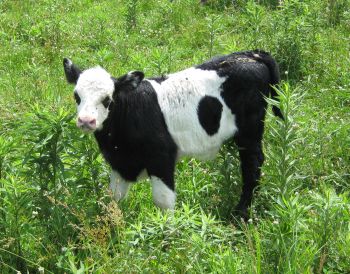
The patterns aren't exact. The one you see here (with the polka-dot) had a mother with a white face. He's called "Panda". Ugly by the Belted Galloway show standards - beautiful to us and his momma.

Galloways are also known for their quality lean beef. They put on a thicker hair coat in winter instead of extra backfat. This means that they also are known for higher CLA's and a better Omega 3 and 6 ratio - both of which are touted as being more heart healthy.

We are continuing to save back our heifers to replace our older cows and so will soon be having our own Beltie-Angus cross cows as well as the solid black and a few black-white-faced momma's.

All this to ensure we can raise the finest beef possible for our local customers, all locally processed and source-verified.

Just so you can eat better, even though it means our beef is striped.
Enhanced by Zemanta

Monday, March 8, 2010

New Calf - New Breed?


Well, this little cuss was born yesterday and was up and kicking his heels within hours. Quite a beauty.

He's a cross between a Belted Galloway (Beltie) bull and a white-faced Angus cow. That's how he's gotten his darling Panda looks.

The advantage of the Beltie/Angus cross is that you get the faster weight-gain of the Angus with the improved forage efficiency of the Beltie - who is rumored to eat almost anything out there. We've had one other last year, a heifer, who is already known affectionately as "Little Goat".

Combined with our shift to managed grazing, ultimately to a "mob stocking" level, we will be able to produce an improved efficiency through our crossbreeding and forage management.

I'm working on a whitepaper about this subject, so should have more information for you shortly. And I have to get a video of this new little one for YouTube...

But our lives are already enriched.
Posted by Picasa