Showing posts with label Agriculture. Show all posts

Wednesday, December 2, 2015

How to Select Replacement Heifers

Beltie-Angus cross stock from Worstell Farms make great replacement heifers.
This is "Sidesaddle" and her heifer calf from earlier this year. Note the good body condition just a week or so after birthing.
(Found this article by veteran rancher and herdquitter Kit Pharo. Thought you might be able to use it.)

Q and A –
By Kit Pharo

Question: Hi Kit, I was wondering how you select replacement heifers from your herd – or do you have some suggestions on how I should select my heifers?” 
Answer:
Enough articles have been written about the proper way to select and develop replacement heifers to fill a large barn.   Guess what?   It’s not really that complicated.   I don’t know why everyone is so determined to complicate simple matters, but they are.

Weaned heifer calves that have been saved for replacement females will not generate any income for two years.   Therefore, ranchers simply cannot afford to invest much money into their development.   Rather than place them in a high-input, artificial environment and haul expensive feed to them, we need to treat them like the cows we hope they will become.   They need to be out foraging for themselves, with minimum inputs.   If a heifer can’t do this, she probably won’t make an efficient and profitable momma cow.

We suggest you retain nearly all of your heifer calves, rough them through the winter and expose them to a bull for a very short period of time.   This system will allow only your most efficient and early maturing heifers to advance into the cowherd.   Why not let the environment sort out your best replacement heifers?   The remaining heifers can be treated as stockers and sold for a profit.

If you breed your heifers to calve when God intended them to calve, you will be amazed at the high number that will conceive during the first 21 days of the breeding season.   Even heifers that were cheated during the winter months are able to catch up with two to three months of good green grass prior to breeding.   If you end up with more bred heifers than you need, you can sell the extras for a profit.   I suggest you let the buyer select from the herd, because he won’t be able to pick out the best ones any better than you.

So what about selection?   You and I are NOT capable of doing as good a job of selecting replacement heifers as the environment can do.   Form will follow function if we stay out of the way.   However, there are a few things that deserve to be looked at.   Here is my list.

1.     Get rid of the outliers, dinks and freaks.   In many herds, this includes some of the tallest heifers.
2.     Watch disposition.   Cull those with flighty and/or nervous dispositions.
3.     Look at feet and leg structure.   Any problems you see now will only get worse.
4.     Select for heifers that shed the quickest.   Cull heifers with dull, dead looking hair.   This is an excellent indicator of health and adaptability.
5.     If you still think you need to do some more culling and/or selecting, you can look at conformation.   I prefer heifers that are shorter, thicker and easier fleshing.   The more pounds per inch of height, the better.   I cull heifers that look long, because that means they are gutless.   Contrary to what show ring judges tell us, body length is an optical illusion.   I also cull heifers that are coarse and/or masculine in appearance.

Keep the pressure on…   We run our replacement heifers with our mature cows.   They receive no special care.   We calve our heifers out on open range with the cowherd.   This continues to force the inefficient and unadapted females out of our program.   The sooner you identify the heifers that can’t make it, the better.   Every replacement female should have to earn a place in the cowherd.

Friday, June 5, 2015

What's an Auction Sound Like?


You may have never been to a livestock auction.

I had to take two of our older cows and their calves today - because they didn't fit in to our scene as I "downsize" the herd to a smaller frame size and white belts on everything.

Anyway, here's how it went when their turn came up:

Hope this educational tidbit is useful.

Sunday, November 2, 2014

Want to really live in a rural-suburban homestead? Now you can...

How to get your own library of rural-suburban lifestyle books...

rural-suburban lifestyle books - so everyone can experience the joys of Nature and natural living.
another gorgeous fall sunrise - with fog

Just taking a break from all my other work. Because you deserve to hear this announcement...

I've been finding and editing classic books (and some more modern ones, too) which tell you how you can be prepared, homestead, or simply learn the skills your grandparents and theirs knew about how to survive and thrive with what you have.

These cover a fairly broad area, but some of the niches include:
  • gardening
  • organic and natural farming
  • dogs and horses, training and care.
  • farm outbuildings - how to build shacks, shanties, and barns
  • farm mechanics - how to fix or build about anything.
  • preparedness - first aid, survival techniques
  • etc.
And I'm going to start publishing them here so you can share in these discoveries.

Meaning, you can start eating better quality food, preparing it in healthier ways, finding natural ways to improve your health, and live better than ever before. (Well, at least you'll have the option. Your mileage may vary...)

This means I'm expanding Worstell Farms beyond quality Missouri grass fed beef.

I also operate Midwest Journal Press as it's director. My "day job", so to speak.

And while I can service maybe a dozen or so clients who can drive inside Missouri to pick up my beef, I can also help people internationally with references and material that enable them to improve their lives by living more in harmony with Nature - specifically, getting to understand natural laws and principles.

This means all the areas above.

You see, I've found out that there are a heckuva lot of books which have never been re-published or promoted properly. And some great books are available only as overpriced textbooks when the material itself is in the public domain.

Since I've studied up on how to find these books and publish them, you benefit by being able to get both the ebook version for your smartphone/phablet/ereader - or get the print edition (without having to pay an arm, leg, first-born, etc.)

It's some work, but seems to be worth it - as people want to buy these books. (There's one book on grazing which everyone refers to, but no one has ever set up an online course to train people straight from the facts he set out in 1959.)

So I'll be able to get these books and enable you to read, study, and apply them to improve your life - wherever you live, even if it's not on a farm.

You've already seen me post one book on this ("Domestic Animals" by Richard Allen.) Look for more shortly (there will be about 50 of them here, with many more in the pipeline.)

And that's the news today.

Monday, February 10, 2014

Greenhouse Gas Lies Exposed - Facts about Grass Fed Cattle Flatulence...

Grass Fed Cattle are Carbon Negative (and Flavor Positive!)

Found this in a more recent Kit Pharo newsletter:

Reality of Ruminents and Conventional Wisdom of CO2 emissionsTaking Out the Carbage
By Peter Ballerstedt
PeteB@GrassBasedHealth.com
www.grassbasedhealth.blogspot.com

I’m preparing for my participation in the 2012 Ancestral Health Symposium (http://ancestryfoundation.org/).  The symposium will take place at the Harvard Law School August 9th-11th.  Not a bad gig for a forage agronomist!  The title of my presentation is The Reality of Ruminants and Liebeg’s Barrel: Examining the New ‘Conventional Wisdom'.  One of the themes of this year’s symposium is sustainability.  I don’t see that term in the simplistic way many do, in part because I remember being told by leaders of the sustainable agriculture movement that “animals have no place in sustainable ag!”

The truth is that the production of animal products from perennial forages is the sustainable agricultural system.  Many, however, are concerned about the carbon dioxide and methane “emissions” from livestock in general, and cattle in particular.  Some folks don’t seem to understand that a cow grazing grass can only emit carbon that was originally in grass, and that the carbon in grass has to have come from the atmosphere.  So it’s a cycle, not an “enrichment.”  But there’s more to it than that!

Under the following assumptions:

Carbon/Nitrogen ratio = 17 and 3.4% N, giving 57.8 % C
3% of body weight daily dry matter (DM) intake; 1,000 lb cow = 30 lb DM per day
70% utilization - 30 lb DM eaten / 0.70 = 42.8 lb DM offered
Equal above and below ground DM distribution
90% of C consumed is “emitted”

We’d see:
42.8 lb DM above ground, 42.8 lb DM below ground – 85.6 lb DM total
57.8% C in DM – 49.5 lb C total
17.3 lb C consumed
15.6 lb C emitted

For every pound of carbon “emitted” by a cow on grass, 3.2 pounds of carbon are fixed in plant roots, uneaten plant debris, or the cow herself or her calf.  Even if 100% of carbon she ingested is emitted, there’d be 2.9 pounds of carbon fixed for every pound emitted!  Beef cattle are carbon negative!
Enhanced by Zemanta

Sunday, February 9, 2014

Can Wholesale Meat Prices Afford a Beef Ranch?

How does a Beef Ranch Stay in Business?

How to you keep a beef ranch in business?Simple answer: income greater than expenses and needed reserves. Makes running a beef ranch seem simple.

This was the problem I encountered when I took over farming. Most (and we still do, at this point) maintain a second job away from the farm. Because (as "everybody conventionally knows") you keep farming until the money runs out. It's that second job which pays the costs of farming when the crop doesn't.

It's the commoditized base of farming which is keeping dirt-poor farmers dirt-poor.

We studied this over and over and kept coming up to the same conclusion. Getting big doesn't make your farm more profitable. Studies show that about 300 acres is the max on cost breaks with the income/expenses leverage. More acres above that and you are doing longer hours with the same basic cost per acre. It's how many acres can you farm to replace your day job income. Not less hours or easier work.

Now you have to get smart about what you are doing. We really have nothing bad to say about corn-fed/lot-finished beef (other than it has no taste, really - IMHO). But if you are selling a lot of bland burgers at a discount price, this is exactly what you want. And that is the commodity beef business. Why packers are vertically integrating to cut out middleman costs.

Our difference with them is that when we started crunching numbers, we found that our best profit point was to get away from corn-fed beef entirely. Half our annual crop was going to pay for feed costs. The next year we made more money simply selling them as feeders (just weaned) and stayed in the warm house more often than filling grain feeders in the middle of winter and fixing broken/frozen water lines.

The next breakthrough was learning we could almost double that by simply selling them as yearlings (one year old) to other people who had feed lots with cheaper corn and hated staying inside all winter. Kept my weaned calves on hay with the other cows and calves and we still stayed in the warm house more.

The next point was finding that if we manage our grazing and have leftover tall grass in the pastures, we can make less hay and so take my expenses even further down. That's because we're moving to grass-fed beef with managed grazing (ultimately right on up to ultra-high-density stocking aka "mob" grazing) .

Funny thing is: the more naturally we raise our beef, the cheaper it gets to raise it. So farm profits rise. It's not "buy more land and work longer and harder", it's "manage what we have smarter and work less".

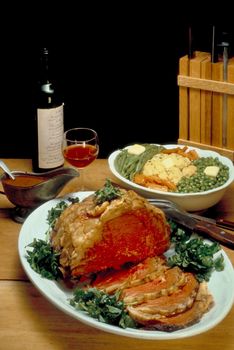
OMissouri Beef Ranch Roasts taste great!f course, the next up from that is where you come in. Where we sell directly to the client, and keep them happy with what they get, we can make more than we would when we send them to the auction.  Not a lot more, but it will make our farm more and save you a lot more by getting you to buy higher quality beef that you can inspect yourself for much less than you would pay else where for similar or lesser quality.

If you buy the whole cow direct from us, we can get you 600 pounds of beef for about $2.00 a pound (right this second, anyway - prices change all the time). And that's the average price of the Gawd-knows-where-it-came-from-or-how-it-got-here variety hamburger in the supermarkets. And you get steaks and roasts and filets-mignon's all for the price of that questionable hamburger.

But all that beef won't fit in the average home freezer. And it's a huge chunk of cash to spend at once. So we use a local marketer to find clients and we sell the beef to four people at once. They each drive off with about 150 pounds. But it costs them a little more per pound so that the marketer makes enough to keep selling this stuff, and our farm still gets a little above sending it all to auction. And the customer knows exactly where that beef came from - food security.

The answer is still the same. We keep figuring out how to help Nature do what She does best, and She rewards me in the marketplace with more of this funny green stuff that cattle won't eat and bankers will.

That's how our farm stays in business.
Enhanced by Zemanta

Saturday, February 8, 2014

Some Online Resources for Intensive Grazing - Links and PDF's

One of the popular pages I've had for years is where to get PDF's about Intensive Grazing.


Here's a recent round up from ATTRA - great downloads.

ATTRAnews August 2013 - Newsletter of the National Sustainable Agriculture Information Service

Intensive Grazing Resources

ATTRAnews August 2013 - Newsletter of the National Sustainable Agriculture Information Service

ATTRA Resources for Intensive Grazing

The following ATTRA publications and resources include useful information related to intensive grazing management. These resources and many more can be found in the Livestock and Pasture section of ATTRA's website, www.attra.ncat.org. Call 800-346-9140 for a printed copy. Prices vary. Many resources are free.
SP* titles are also available in Spanish.


ATTRA's New Publications about Intensive Grazing Management

ATTRA publications Icon
Enhanced by Zemanta