Showing posts with label beef cattle. Show all posts

Tuesday, March 31, 2015

Classic: Michael Graham's Soil and Sense

New Release! Soil and Sense by Michael Graham


Here is the crux of the matter, as I see it. The food for men cannot be grown unless the land is also fed. That goes almost without saying. It is also true that the folded sheep are reduced in number and that the great heaps of dung from the bullock yards are not so common as they were. These were the stores of fertility that the country, mainly relied on, but we do not hear that they are to be restored. Instead there is talk of ploughing-out grassland, and of the proper use of fertilizers. I find that insubstantial.

On the face of it there is a case for serious inquiry. Perhaps someone knows that the land is being fed rightly, 'but no-one has explained it to me and I cannot find that anyone else is better informed.

I searched the public library for a short book that would give the key to this puzzle, but I did not find what I wanted. There were indeed some good books by good scientists and they are in my list of references at the end of this book, but they each dealt with only a part of the problem. For example, books that described the soil bacteria made no mention of landlords.. The popular books on agriculture included novels, biographies, and essays, but these all avoided technical details, and it is difficult to state or solve a practical problem without setting it against a background of details.

Because I found no one book, I had to wrestle out the problem for myself, from various books and with the help of such experience of the land as a man may gain in his leisure. This, then, is a short book on the central problem of agriculture, that is the quality of soil.

First published 1941

- - - -
eBook now available:
Buy now

http://itunes.apple.com/us/book/isbn9781312403574
http://www.amazon.com/dp/B00MERYPJE

Trade paperback (6"x9", 154 pages) available on Lulu and soon on Amazon and all brick-and-mortar bookstores:
Support independent publishing: Buy this book on Lulu.

Tuesday, January 13, 2015

The Cow and Her Grass - Andre Voisin

Classic: The Cow and Her Grass, a Manual of Grass Productivity - by Andre Voisin

Get Your Copy of The Cow and Her Grass by Andre Voisin - Today!


This book by Messrs Voisin and Lecomte comes at the right moment. It is a synthesis of M. Voisin's important study, Grass Productivity. This manual presents the chief ideas of two specialists. Since they are also excellent practitioners, they have applied these ideas before recommending them.

Their evocative picture of 'the meeting of cow and grass' poses the true problem of the management of grazed grass.

For the farmer, the production of meat and milk is an act of industrial conversion. The 'machine' is the animal that converts raw vegetable matter into finished food products which are rich in calories and easy to assimilate. This 'machine' is complex because it is a living being; it can be improved--within limits. But its yield depends basically on the quality of the raw materials offered to it for conversion. 

Our farmers bring a jealously guarded care to the cultivation and harvesting of their cereals and commercial plants. Too often they rely on nature to develop their pastures and let their animals use their instinct to get the best harvest they can from them. 

M. Voisin, an experienced chemist and biologist, has applied foreign studies of grazing on his Norman farm for several years. He has removed the errors and, above all, has looked for a more specifically French application that could be adapted to our traditional farming practices.

M. Lecomte, a Veterinary Surgeon, has studied the complex of forage feeding and its influence on yield and animal health, from observation of grassland management, even that of his clients.

Messrs Voisin and Leconte have drawn on the fruits of their conversations and experience and, in this manual, have succeeded in producing a popular version of the fundamental ideas of their studies.

I hope that their words will be heard and followed.

[From the Introduction]

- - - -

Get Your Copy Today!

"The Cow and Her Grass" by Andre Voisin, A. Lecomte on Ganxy

eBook now available:


http://itunes.apple.com/us/book/isbn9781312403574
http://www.amazon.com/dp/B00MERYPJE

Trade paperback (6"x9", 66 pages) available on Lulu and soon on Amazon and all brick-and-mortar bookstores:
Support independent publishing: Buy this book on Lulu.
This book by Messrs Voisin and Lecomte comes at the right moment. It is a synthesis of M. Voisin's important study, Grass Productivity. This manual presents the chief ideas of two specialists. Since they are also excellent practitioners, they have applied these ideas before recommending them. Their evocative picture of 'the meeting of cow and grass' poses the true problem of the management of grazed grass. For the farmer, the production of meat and milk is an act of industrial conversion. The 'machine' is the animal that converts raw vegetable matter into finished food products which are rich in calories and easy to assimilate. This 'machine' is complex because it is a living being; it can be improved--within limits. But its yield depends basically on the quality of the raw materials offered to it for conversion. Our farmers bring a jealously guarded care to the cultivation and harvesting of their cereals and commercial plants. Too often they rely on nature to develop their pastures and let their animals use their instinct to get the best harvest they can from them. M. Voisin, an experienced chemist and biologist, has applied foreign studies of grazing on his Norman farm for several years. He has removed the errors and, above all, has looked for a more specifically French application that could be adapted to our traditional farming practices. M. Lecomte, a Veterinary Surgeon, has studied the complex of forage feeding and its influence on yield and animal health, from observation of grassland management, even that of his clients. Messrs Voisin and Leconte have drawn on the fruits of their conversations and experience and, in this manual, have succeeded in producing a popular version of the fundamental ideas of their studies. I hope that their words will be heard and followed. [From the Introduction] ....

Tuesday, April 15, 2014

Why our prices haven't gone up like everyone else.

Because we don't feed corn - and our costs haven't (really) gone up.

We don't raise the beef just to increase our profit margins.
 (photocredit: LandingMemo)

The point is to provide real value.

And that's not just limited to some of the best-tasting beef you can find for wholesale prices. It's treating people like family, or better. (We're working constantly to improve on that point.)

We're looking to get regular clients. That's more valuable than getting everything sold from year to year. Our prices are decent enough we don't have to rely on the auctions.

At this point, we have another value to add - prices lower than average, and higher quality than any supermarket. Plus you know where it comes from and you can visit to find out exactly how we raise them.

Sure, I don't get all the pictures, and stories, and videos up for you. Running a cattle farm keeps you more than busy. We're transitioning to only raising beef (don't need grain for anything much) and otherwise, working to put in permaculture everywhere else. At least I could get this blog post out.

Again, doing this just drops the cost of everything. The cattle do their own cultivation, fertilizing, and harvesting. Turning everything to meat. For you and yours.

Corn-feeding farmers have the problem of high corn prices (and beef that's as tasteless as chicken.) The drought messed up a lot of good pastures for the last few years, which has put a dent in the number cows available.

Meanwhile, China and other countries have improved their quality of life (so much so that some manufacturing is returning to Mexico and the U.S.) Their higher pay has them reaching for more beef. And their fears of Avian and Swine flu has them dropping the demand for chicken and pork.

Unfortunately, the drought has also raised prices on all sorts of other foods.

So we are all suffering under increased food budgets.

Meanwhile, the cost of our farming business hasn't gone up that much. We still buy hay and fencing supplies, but those haven't increased too badly.

Instead of just becoming another profiteer, we've simply kept things the same. 

The reason? To be able to keep regulars on board, to treat them fair, as well as we do our family.

We always have the auction as a back up. Especially these days - even through they'd rather have all-black, instead of our striped ones.

Our concentration is to keep this herd paying its way. They are to cover the entire costs of the farm, make it sustainable from here on out.

You'll note that I've taken the contact form down. Because I'm getting way too many new people coming my way. If I were just selling digital books, this would be fine. But we only raise about 10 steers a year, and that just goes so far.

We're extending the privilege of  being able to process your own beef and share it with your friends and family. That's the law.

So you buy a share (or whole) from us and then pay your processor when you pick up your meat. Simple. We take care of raising it for about 2 years.

Your welcome.

So - if you haven't already signed on with us, then send me an email. Or call me - and then send me an email. All that info is on the contact page.

But our prices don't have to change now. Your choice.

Sunday, February 9, 2014

Is Your Best Health Food Really Meat? Science Says Yes.

How Missouri Beef is Your Best Health Food

Now there has been some discussion about the heart-healthy aspects of Missouri grass-fed beef – an all-natural health food. Here's a pretty well-documented summary from Eat Wild (http://www.eatwild.com/healthbenefits.htm):

Summary of Important Health Benefits of Grassfed Meats, Eggs and Dairy

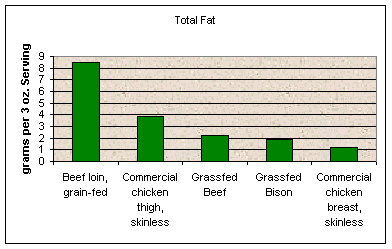
Lower in Fat and Calories. There are a number of nutritional differences between the meat of pasture-raised and feedlot-raised animals. To begin with, meat from grass-fed cattle, sheep, and bison is lower in total fat. If the meat is very lean, it can have one third as much fat as a similar cut from a grain-fed animal. In fact, as you can see by the graph below, grass-fed beef can have the same amount of fat as skinless chicken breast, wild deer, or elk.[1] Research shows that lean beef actually lowers your "bad" LDL cholesterol levels.[2]
Total Fat per gram of serving grassfed beef makes it a health food.
Data from J. Animal Sci 80(5):1202-11. 

Because meat from grass-fed animals is lower in fat than meat from grain-fed animals, it is also lower in calories. (Fat has 9 calories per gram, compared with only 4 calories for protein and carbohydrates. The greater the fat content, the greater the number of calories.) As an example, a 6-ounce steak from a grass-finished steer can have 100 fewer calories than a 6-ounce steak from a grain-fed steer. If you eat a typical amount of beef (66.5 pounds a year), switching to lean grassfed beef will save you 17,733 calories a year—without requiring any willpower or change in your eating habits. If everything else in your diet remains constant, you'll lose about six pounds a year. If all Americans switched to grassfed meat, our national epidemic of obesity might diminish. 

In the past few years, producers of grass-fed beef have been looking for ways to increase the amount of marbling in the meat so that consumers will have a more familiar product. But even these fatter cuts of grass-fed beef are lower in fat and calories than beef from grain-fed cattle.

Again, there's nothing about grain-fed beef that's inherently bad. It's feeding our nation right now and doing just fine at that. Factually, it's not the beef that is the problem, it's the lifestyle and the other fried foods which are also adding in additional fat content, which most people don't work off while sitting in front of the TV or video game.

But that's another discussion for another time.

Come, do a working vacation out at our farm and walk a couple miles with me every day in heavy boots and humid weather - that will start melting the pounds off...

References:

1. Rule, D. C., K. S. Brought on, S. M. Shellito, and G. Maiorano. "Comparison of Muscle Fatty Acid Profiles and Cholesterol Concentrations of Bison, Beef Cattle, Elk, and Chicken." J Anim Sci 80, no. 5 (2002): 1202-11.

2. Davidson, M. H., D. Hunninghake, et al. (1999). "Comparison of the effects of lean red meat vs lean white meat on serum lipid levels among free-living persons with hypercholesterolemia: a long-term, randomized clinical trial." Arch Intern Med 159(12): 1331-8. The conclusion of this study: "... diets containing primarily lean red meat or lean white meat produced similar reductions in LDL cholesterol and elevations in HDL cholesterol, which were maintained throughout the 36 weeks of treatment."
Enhanced by Zemanta

Monday, December 6, 2010

Tips to winterize your cow herd

by Amy Radunz, Beef Cattle Extension Specialist, University of Wisconsin-Madison
(Blogger note: I've included this from the OSU weekly Beef Cattle letter, as an article worth sharing in it's entirety. There's a lot to be said here about how to set up your cattle to survive and thrive through the winter. Mostly, you don't expect more than minimal gain, since the best hay isn't the same as fresh grass. But the trick is to ensure they don't go backwards. So these tip and linked sites will help any cattle producer large or small. I only wish I'd run across this in about September…)

feeding-cattle The fall is coming to an end and for most farmers the crops are harvested, the calves weaned, and cows are preg-checked. This is a great time for farmers to make plans for the winter for the cow herd and if you take the time now to plan how to feed cow herd this winter, this can pay dividends in the spring and summer. So here are some simple tips to help winterize the cow herd.


1. Body condition score your cows. Weaning is great time to body condition score your cow herd. If you didn't get this done, its not too late to do this before there is snow on the ground. After the calf is weaned, this is the period when a cow's energy requirement's are her lowest and cows can easily gain body condition during this period. Therefore, for your young and thin cows this would the most economically time to put on some body condition prior to winter and calving. One of the most mismanaged groups of cows in the herd is the young cows (3 to 4 years old) and can often be overlooked and farmers should pay close attention to energy reserves of these cows. By feeding your cows now to have a body condition score of 5 or 6 calving could pay dividends in the upcoming breeding season, since body condition score at calving is highly correlated to postpartum reproductive performance. Video on body condition scoring of beef cattle by Purdue University Beef Team

2. Conduct a forage test on winter feeds. This can be valuable information to determine a winter-feeding strategy. This allow producers to match forages to right stage of gestation and age of animal. Energy and protein intake of the cow during gestation is critical not only to her performance but the development of the calf. If cows do not intake enough protein or energy, this could lead to weak calves at birth, postnatal health problems, or poor growth performance. On the other hand, with rising feed costs farmers cannot afford to overfeed their cow herd. By knowing the quality of the forage, you can determine intake of feed instead of the cow, which will in turn save on feed expenses. Video on tips for forage sampling by Iowa State University Extension

3. Make culling decisions. The easiest decision is to cull those cows and heifers which are determined open in the fall. Farmers can be tempted to give cows and especially heifers one more chance, but with rising feed costs can you afford to keep this unproductive females in the herd? There are several other factors to consider when making culling decisions. Unsound udders, lameness and poor mouths should enter the culling list. These could significantly impact the performance of the cow in the coming year. Disposition is another important factor in making culling decisions, not only for your safety but these cows can pass these traits to their calves and the calves are typically lower performing.

4. Decide on heifer replacement strategy. After making culling decisions, you can determine how many replacement heifers you will need. But some important questions to ask first are: Can you afford to develop your own replacement heifers? Or would you be further ahead to purchase bred heifers to replenish the herd? The heifer calves are another challenging group to manage in the cow herd, especially in small herds. This decision to keep or buy heifers is dependent on several factors such as current and future market prices, herd size, facilities, available labor, and economics. To decide what is the best strategy, producers should develop budgets and management plans for each option. For more information: Buying vs. Raising Replacement Heifers by Jason Cleere

5. Estimate your winter feed needs. Now you have made the decision on what cows are being culled, how many heifers you plan to keep, and what is the quality of your feed resources, this will allow you to design your winter feeding strategy. First estimate, your winter hay needs and determine if you have enough forage on hand. If you estimate you are short on forage, the fall can be a more economical time to purchase feed than later in the winter or early spring. This is also a good time to purchase grains or by-products to stretch your winter forage supply. Reducing winter feed costs can have a significant impact on the profitability of a cow/calf operation, so planning a head can be beneficial to the bottom line. Tools to help: Estimating Hay Needs Calculator by University of Wisconsin Extension.
These are some simple tips to plan for the winter ahead for your cow herd, which can save time and money in coming months. If you would like more information on the tips outlined here contact your local extension agent.

Monday, October 25, 2010

How about a whole beef in your freezer?

Ran across this article of Jason Krause’s about how he bought a whole beef and worked to figure out what to do with it all. At average usage, a small family will use just over a quarter in a year. Plus it takes a standalone freezer to hold it all.

But this guy went for the whole cow and lived to tell about it…

What’s interesting is the informal solution a New York group figured out. Of course, it’s not something you can legally do in most states – it’s to do with Federal/State laws. But as long as people are in agreement…

Then there was the sheer amount. After three weeks, my wife and I had eaten only a tiny fraction. At that rate, it would take us over a year to finish all the meat. And you really can’t keep it in a freezer longer than a year. I started dreaming of steak, but not in a good way—in an “I have to get rid of this” way.

So I decided to throw a beef party. I borrowed two crock pots and went to work. Hours over the stove produced chili, Italian beef, steak-and-kidney pie, beef bourguignon, and spicy beef short ribs. I invited seven of my friends and family members over, and everyone crammed into our little kitchen and started eating.

My wife made gift bags with spices, a beef recipe, and a couple of pounds of frozen ground beef that the guests were required to take home. We also loaded them up with cooked meat in Tupperware.

At the end of the night, I had unloaded only 50 pounds. I still had easily 100 left.

In the course of my research, I learned there are more sensible ways to buy a side of beef. The aptly named Angus MacDonald organizes a “beefening” each year, in which a group of 20 friends in New York City and Brooklyn split several sides of beef acquired from a farmer in upstate New York. (They also do the same thing with pigs.)

“We’ll often convene late at night, sometimes right on the street in Williamsburg [Brooklyn], and spread out blankets and divide it up right there from the trunk of my car,” says MacDonald. “It must look pretty suspicious to have 15 to 20 people trading white wrapped packages on the street.”

Each person gets an eighth of a steer, or about 40 pounds of meat, for $100 to $150. They trade based on which cuts they prefer. One woman hates the chewiness of steaks, so she trades hers for hamburgers.

Much more sensible.

Of course, there is a probable legal method for handling this – which this group may have solved – buying the beef under the corporate name of the organization. Since they all are members of it, they all share in it’s produce and ownings. But that will be an interpretation of their own state laws. Hope to get a powerpoint up on this shortly.

Stay tuned…

Thursday, November 5, 2009

Why my grass fed beef won't replace any corn for your tortillas any time soon


Sure, I'm just joking about the tortillas - practically, the seeming biggest use of corn is sent to animal food. 1% is sweet corn, 25% goes to ethanol (and the byproduct leftover is then fed to animals), 20% is exported and another tiny bit is used for food ingredients, chemicals, fabrics, and plastics. (Source: EcoProducts)

But one of the big whoppers being told by the "animal rights" activists and other enviro's is that cattle are taking the land we'd be growing crops on.

Look, I'm from Missouri, where we are #2 behind Texas in raising cattle. If the land is good enough to raise profitable crops, you won't see a cow anywhere near it.

Good crop ground makes between 150 - 200 bushels of corn an acre. It takes 2.5 acres to keep a cow alive in Missouri (more out West.) So if you are getting $800 for a full-grown steer or could take those 500 bushels of corn off those same 2.5 acres and sell them at $4 each ($2,000) - which would you do?

That's probably why we shifted over to feeding cheap corn to cows instead of having them munch away at prairie grasses. But you will also see the big feedlots in crop country, not down in the rolling hills that start where I live and keep going further down into southern Missouri.

But I'm awfully tempted to take the rest of my 45 acres I farm as crops and convert it to pasture. Why? Because it doesn't make but about 80 bushel per acre of corn. And the cost per acre is the same, whether you get a 200 bu. yield or nothing.

Crunching the numbers for the land I have showed that I got about $2,000 profit off those 45 acres last year. Pays the taxes and the bills, barely. Now, say I had a crop which didn't require inputs and was pure profit. 45 acres should keep about 18 more cows. If I sell their calves at about $600 profit, then I make $10,800 - so which is more profitable?

That's what these other big-city complainers just don't get - cattle are raised on marginal land which won't produce any decent sort of food otherwise. Our own farm land is all marginal, even the stuff we crop right now. Mostly trees, shrubs and clay ground under about 2-3 inches of top soil. Raises better grass and trees than anything else.

You go 40 miles north or east and it's a different scene. 6-8" topsoil and that 200 bu. corn I mentioned earlier.

The trick is to raise that low-maintenance, low-input, environmentally-friendly grass fed beef.

Because the land only gets better when you raise your beef right. And the quality of the beef is the best that can be produced. Award-winning and lab-tests to prove how heart-healthy it is.

And it will make this farmer improve his own rural lifestyle by being able to maybe quit his day job - one day, anyway.

If you follow what Nature laid out, not the government, you generally have an easier time of it. At least, that's what I've experienced.

Try it for yourself and see...

- - - -

While I raise my own grass-fed beef here in Missouri, I suggest you try a vendor such as La Cense Beef if you want to sample some truly wonderful, Montana-raised grass fed beef.