Showing posts with label Food. Show all posts

Tuesday, January 13, 2015

The Cow and Her Grass - Andre Voisin

Classic: The Cow and Her Grass, a Manual of Grass Productivity - by Andre Voisin

Get Your Copy of The Cow and Her Grass by Andre Voisin - Today!


This book by Messrs Voisin and Lecomte comes at the right moment. It is a synthesis of M. Voisin's important study, Grass Productivity. This manual presents the chief ideas of two specialists. Since they are also excellent practitioners, they have applied these ideas before recommending them.

Their evocative picture of 'the meeting of cow and grass' poses the true problem of the management of grazed grass.

For the farmer, the production of meat and milk is an act of industrial conversion. The 'machine' is the animal that converts raw vegetable matter into finished food products which are rich in calories and easy to assimilate. This 'machine' is complex because it is a living being; it can be improved--within limits. But its yield depends basically on the quality of the raw materials offered to it for conversion. 

Our farmers bring a jealously guarded care to the cultivation and harvesting of their cereals and commercial plants. Too often they rely on nature to develop their pastures and let their animals use their instinct to get the best harvest they can from them. 

M. Voisin, an experienced chemist and biologist, has applied foreign studies of grazing on his Norman farm for several years. He has removed the errors and, above all, has looked for a more specifically French application that could be adapted to our traditional farming practices.

M. Lecomte, a Veterinary Surgeon, has studied the complex of forage feeding and its influence on yield and animal health, from observation of grassland management, even that of his clients.

Messrs Voisin and Leconte have drawn on the fruits of their conversations and experience and, in this manual, have succeeded in producing a popular version of the fundamental ideas of their studies.

I hope that their words will be heard and followed.

[From the Introduction]

- - - -

Get Your Copy Today!

"The Cow and Her Grass" by Andre Voisin, A. Lecomte on Ganxy

eBook now available:


http://itunes.apple.com/us/book/isbn9781312403574
http://www.amazon.com/dp/B00MERYPJE

Trade paperback (6"x9", 66 pages) available on Lulu and soon on Amazon and all brick-and-mortar bookstores:
Support independent publishing: Buy this book on Lulu.
This book by Messrs Voisin and Lecomte comes at the right moment. It is a synthesis of M. Voisin's important study, Grass Productivity. This manual presents the chief ideas of two specialists. Since they are also excellent practitioners, they have applied these ideas before recommending them. Their evocative picture of 'the meeting of cow and grass' poses the true problem of the management of grazed grass. For the farmer, the production of meat and milk is an act of industrial conversion. The 'machine' is the animal that converts raw vegetable matter into finished food products which are rich in calories and easy to assimilate. This 'machine' is complex because it is a living being; it can be improved--within limits. But its yield depends basically on the quality of the raw materials offered to it for conversion. Our farmers bring a jealously guarded care to the cultivation and harvesting of their cereals and commercial plants. Too often they rely on nature to develop their pastures and let their animals use their instinct to get the best harvest they can from them. M. Voisin, an experienced chemist and biologist, has applied foreign studies of grazing on his Norman farm for several years. He has removed the errors and, above all, has looked for a more specifically French application that could be adapted to our traditional farming practices. M. Lecomte, a Veterinary Surgeon, has studied the complex of forage feeding and its influence on yield and animal health, from observation of grassland management, even that of his clients. Messrs Voisin and Leconte have drawn on the fruits of their conversations and experience and, in this manual, have succeeded in producing a popular version of the fundamental ideas of their studies. I hope that their words will be heard and followed. [From the Introduction] ....

Tuesday, June 24, 2014

Next Step: Building a Buyers Club For All-Year Beef Supplies (and More)

Our predicament is your gain - "from each dilemma, a new opportunity is found."

(Our latest calf - "Ears")
The story is that we had two bulls at the home place, and some heifers and cows we didn't want bred. Bulls fight over females, so we couldn't turn both out with the cows and heifers - yet we also didn't have three places we could keep everyone happy and well fed.

So our youngest bull is slated to be processed. But no buyers lined up.

Which means we have to stock an empty freezer - in spite of everything we already have in there.

The solution is to re-implement our Buyer's Club.

What this means is that the Buyer's Club itself buys the animal, and any member may share in the purchase. That falls within the custom-exempt law for processing.

Today, we're opening this up to new members. 

There will be a free membership, which will be informative only. A mailing-list, actually.

A paid membership (which is credited on first purchase) will be required to be part of the beef distribution.

Anyone who has already purchased from us is already a Buyer's Club member.

Too simple:
  1. Sign up on the form to the right and give us your email.
  2. We'll send you regular emails with what is currently available and upcoming, as well as related offers when we find other farmers with goods for purchase, and also what our processors have available. (Just one email a month as long as you stay subscribed - and you can opt-out at any time.)
  3. You buy what you want, or sign up for an upcoming beef-share. 
When you buy as a member direct, then you'll need to pick your beef up from us directly (we do not ship, as it's to expensive.)

If you buy a share in a beef, then you'll pick it up directly from the processor.

Of course, you can also get several people join in and a single member can pick up the order for everyone.

This gives us considerable leeway in distributing the various cuts. (Some people like liver, tongue, and heart, for example.) As well, when we have a "hamburger" cow, we can deal with that more easily - as a quarter of a large cow might be too much for some.

Anyway, you get the idea.

Sign up and let us know. 

Monday, February 10, 2014

Farm Income Solution - Wholesale Grass Fed Beef Bought Locally

Finding the Simple Profit in Wholesale Grass Fed Beef
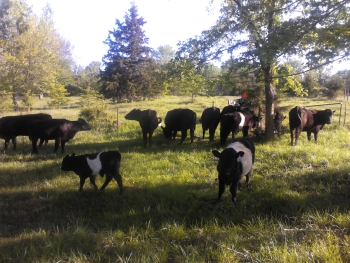
Natural Farming | Grass Fed Missouri Angus Cattle For grass fed beef, you really have just two major profit points – as long as you’re feeding hay:
  1. When they’re weaned.
  2. When they’re yearlings.
Anything else gets eaten up in the winter hay cycle. While a grass fed beef is only about 22 months old at harvest, it’s gone through at least 2 winters, usually 3. Because you have to add in the 9 months of gestation to the cost – which takes it up to nearly 2 1/2 years.

Cost of hay isn’t just baling it, you also have to fertilize the land it came from, or it won’t produce as well for you the next time (and eventually, you’d only be raising short, unpalatable weeds – or sand.)

So working to finish cattle actually takes the remaining profit out of that last 8-10 months. They are going to put on their final weight, but this is also where they lose their efficiency of gain – each pound of gain takes more and more pounds of forage to achieve. And so the relative efficiency of grain-fed beef, who are harvested at about 14 months. That is, if you have the cheap grain to feed them.

Trying to finish cattle on grass usually means another winter of hay, which is additional cost. Auction prices for beef gets you paid commodity prices, which are as low as buyers can get away with. So your fertilizer cost, plus equipment and fuel, eat up any profit from those last few hundred pounds.

Now Missouri has lots and lots of tough, but tasty fescue grass. So this is why it is one of the top beef-producing states. Mostly, it has feeder or stocker (yearling) calves which are then shipped off to feedlots for fattening.

Farmers' Market profits vs. Stockyard Auction prices
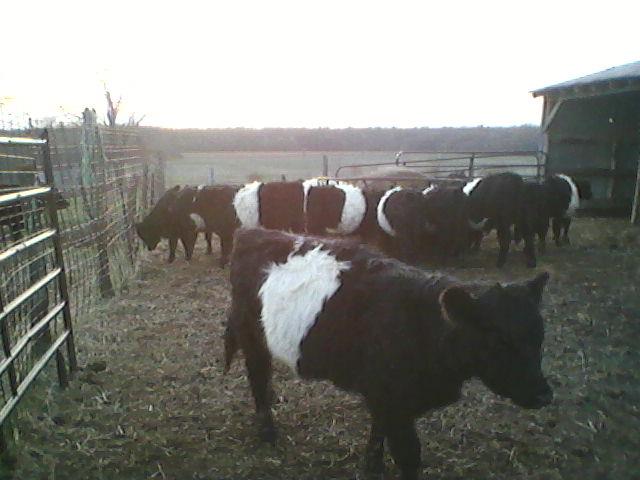
Cattle for Stockyard sale - soon to be shipped.What’s becoming more popular are grass-finished beef, locally marketed. This is where you get your premiums and the reason for finishing anything at all. When you can jump the final price up above your costs for that last year, you can then simply be able to make any profit you want that the final consumer will pay for.

Now while cattle prices are surging all over the place, we are still currently (2012) able to get about $1200 for a steer on the hoof (live-weight). This will give you a your 520-pound carcass and will  another $225 processing. While you get about 320 lbs of useful meat from that, you have arount $400 in that animal. Visiting the local big-city farmers' market found that just hamburger from a verified grass-fed beef was bringing $5.50/lb. and sirloin steak was $18-19.00 per pound.

Now, that was individually wrapped, USDA-inspected. (Which nearly doubles the "custom-exempt" fees.) Your break-even would be covering your costs, and then they pay the processing - that's wholesale beef, custom-exempt processed. At farmers' market prices (adding in the high overhead for big-city booth fees), it still shows that farmers taking over their own market can reap the profit harvest to the tune of somewhere around $3- $4,000 per animal.

If you only sell direct at wholesale prices, you can still take your auction price, add in a premium, and get somewhere around $1,000 profit per animal.
Without taking your own marketing into your own hands, you are really stuck with sellling stockers (yearlings) at auction, your next best profit margin.

Our current model is a mix. We turn the bulls into steers and direct market them as wholesale beef when 2 years old. Heifers are sold as feeders (or if they are lucky, picked up as replacement heifers) and we still more than double cost of keeping them overwinter and their shots. An average profit under this model goes around $14-$15,000 for a herd of 22 cows and bull, without other overhead. That's still got about $4200 in winter hay costs.

To create a sustainable farming solution, increasing profit on grass fed beef at commodity prices is to take out the hay costs – which entails something called mob-grazing. By intensively grazing cattle and letting the land recover (one expert at this says his cows only see the same spot twice a year) – this actually make the grass lusher and means you don’t have to feed hay at all, there’s plenty out there if you ration it during the winter.

The other point would be to get a premium above commodity levels – in other words, quit selling a commodity. This means direct marketing all your annual calf crop. With the Internet, this is getting easier.

If we were making $3,000 per steer by USDA inspection and selling to locals on a per piece basis, that would then be a lot more income, but also a lot more overhead in terms of time and expenses.

But I’ve got far more to study on this. A lot more pencils to sharpen and push. I sure would like to move onto finished cattle, but there’s going to have to be some changes in order to “mine them them hills” of grass to see more gold.

Enhanced by Zemanta

Sunday, February 9, 2014

How to Buy Your Meat Online When You Don't Know a Local Farmer

Not close to our Farm? Buy Beef Online.

A review of U.S. Wellness Meats.

US Wellness Meats - top quality Missouri beef and food products
I know more people see my articles and site than can buy my beef. And maybe people don't want a wholesale beef quarter or half, much less a whole.
And this has led me to research for companies who do the extra step of getting their beef USDA inspected and packaged so they can ship it all over the country (interstate commerce and all those regulations.)

The one company I've found which fits our standards is U.S. Wellness. And interestingly enough, it's also based in Missouri.

This research took me into the reviews as well as to their website. You know that when you ask for "review [website/product]" and only come up with positives, you just hit a home run. Because the best most companies can get is 50% - seriously.

Now the main difference in the way they do beef is that they wet age. This isn't like the big vertically-integrated corporations - which "wet-age" on the truck going from plant to supermarket. They age their beef for 30 days, but vacuum pack the primals. And so the flavor isn't as intense as dry-aged, since the meat doesn't dry out as much. But the enzymes still go to work at breaking down the meat to make it more tender. Meanwhile, they've protected the beef from other pathogens. (See their FAQs.)
Once it's aged to their satisfaction, they then cut it into portions. Then it's frozen - unless you want their fresh chilled beef (a special order) which is never frozen.
According to Local Harvest: http://www.localharvest.org/us-wellness-meats-M24454
US Wellness Meats was founded and is operated by four family farm families who are committed to improving the quality of life for our customers by providing premium quality, health-enhancing grass-fed beef and natural meat products that meet their nutritional needs.
We offer grass-fed beef, veal, bison, lamb, and dairy products as well as certified humane pork, organic snacks, and more. We use no pesticides, herbicides, hormones or antibiotics, or chemicals. Our grass-fed beef is aged 28 days for maximum flavor and tenderness.
(This listing was last updated on Aug 30, 2011)

Location:
204 East Lafayette
Monticello, MO 63457
Contact Information:
John Wood
www.uswellnessmeats.com
(877) 383-0051
Mailing Address:
PO Box 9
Monticello, MO 63457
Farming Practices:
naturally grown, grass fed/pastured, animal welfare/humane certified

Review of U.S. Wellness Products

Fab Rea; Foodie Finds U.S. Wellness BeefAnd this one review (from Real Food Whole Health) I thought to share with you, as it comes from the heart and ahe a lot of good data in it:

Working with our nutritional therapy clients and spreading the real food message of sourcing QUALITY foods, there’s something we hear quite often…” I want to eat healthy real foods, but there’s no store or farm near me that has {insert real food here}”

Grassfed beef, pastured chicken and pork, raw milk cheese from grassfed cows, bacon or sausages made from pastured animals and without nitrates/nitrites, etc. are all healthful foods that can be very difficult to locate in the typical supermarket. It’s true that, in many places it’s difficult to find any of these products even at a local farm, much less ALL from one location. And with our busy lifestyles, it can be hard to find time to go to 5 or 6 different places.


This fantastic family-run business started back in 2000, with just one goal- to provide high quality grass-fed (and grass-finished) beef to consumers. They succeeded. U.S. Wellness Meats grass-fed beef  is recognized for its exceptional taste, quality and health benefits by chefs, professional athletes, and health and nutrition experts, including yours truly.

Today, eleven years later, U.S. Wellness Meats has joined with like-minded small family farms across the country to expand its offerings to include grass-fed lamb, bison, and goat, as well as grass-fed butter and cheese, free-range poultry, pork products, honey, organic nuts and condiments as well as kitchen and personal care products. When you order from U.S. Wellness Meats you know you are getting the high-quality products you want to provide for your family.

....

Overall, our culinary tour of U.S. Wellness Meats was a smashing success and each product I would order again. There are so many more options in their line that I want to try as well- different varieties of raw milk cheeses, rabbit, bison (which I love!) and all the different sausages. There is also an impressive array of organ meats, sourced from healthy animals, and those are nutrient-dense superstars that I am working hard to incorporate into our diet.

The customer service that we’ve received has always been outstanding and the shipping was fast, with extreme care taken to package everything so that it stays protected and fresh during shipping. All of my items were still frozen solid! If you haven’t checked out U.S. Wellness Meats, we highly suggest that you do so- you won’t be disappointed!

Again, that's U.S Wellness Meats - check them out!
Enhanced by Zemanta

What is Dry-Aged and Wet-Aged Meat - and Why Should You Care?

Dry Aged Vs. Wet Aged

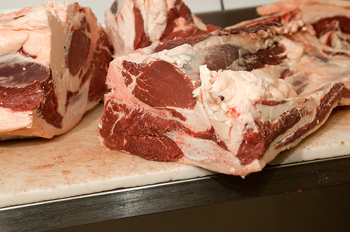
Healthy Meat: Dry-Aged or Wet Aged beef is your choice.There is always some discussion about how to prepare your meat – is it dry aged or wet aged? All meat has to have a cool-down period to get the temperature down, not just in Missouri. There is a minimal delay needed from the time the live beef is delivered and the wrapped, frozen packages are ready for pick-up and delivery.

Meat should be aged before it is cut and wrapped. This increases tenderness.

I found this PDF called "Beef and Part Whole Animal Buying Guide" from the Iowa State University Extension, which says:

Beef Aging

Aging, measured in days, refers to the time from when the animal is slaughtered to when the beef carcass is broken down into retail cuts. Beef purchased directly from farmers or ranchers and processed by a local butcher will typically be “dry aged,” meaning the carcass will hang in a walk-in cooler while aging. “Wet aging” is a process used to age wholesale beef cuts in vacuum packaging and not often used by smaller-scale meat processors.

Dry aging beef does three things:

1. Improves meat tenderness

2. Increases “beefy” flavor

3. Causes meat to lose weight through evaporation

...Additionally, beef that is "hanging" takes up the butcher’s limited cooler space, so you can expect to pay a fee for additional aging. The desirability of the increased beefy flavor that develops through extended aging is purely personal preference. Aging beyond 28 days may result in off flavors. Confirm with your butcher how long your beef carcass will be aged.

As a general rule, younger animals will be more tender than older animals and fatter animals will be more tender than leaner animals.

The general average is about 2 weeks, while traditionally beef has been aged for 3 weeks. Most of the tenderizing occurs in the first couple of weeks, with additional flavor and weight loss occuring later.

Wet aging is simply cutting and wrapping the beef in air-tight plastic immediately. This is used by corporate processors, as it tends to preserve the color. As well, it takes up much less locker space. Some beef has been anecdotally reported to be "aged" as it's shipped from plant to plant. Some plants deal with the live animal, then cut and seal the "primals", which are then loaded onto trucks.

These primal cuts are shipped to other plants which can deal with rendering them into smaller cuts, as well as packaging them for various food store chains. Finally, it's shipped to your local supermarket, where it finishes it's "aging" in the display case - sometimes less than a week from the time it was a live animal.

The processors we use do not use wet-aging.

We use traditional dry aging, hung in lockers and then parted out. These are then sealed in plastic and frozen to preserve their flavor and quality.

Our experience is that wet-aging simply doesn't result in the best-tasting meat. Along with the corn-fed diet, beef can wind up quite bland through this quick-aging process.

Grass fed beef, properly dry-aged, is a delight to eat - both tastier and healthier for you.
Enhanced by Zemanta