Showing posts with label United States. Show all posts

Wednesday, October 1, 2014

Why all grass fed meat producers aren't the same.

If you're looking for wholesale grassfed beef around Columbia MO - you need to ask the right questions.


I was reminded of this today when a new client from Kansas City came by to pick up a whole beef. He said that he picked my beef because I was straight up with how I fed my beef.

We only give them as much grass as they want. Of course I do give them some little treats, like wild apples and green pears (and occasionally a piece of corn-on-the-cob) to train them to literally eat out of my hand. And some mouthfuls of sweet-feed (has mollases in it) - which rattles in a bucket and is a nice tool to lead a whole herd at once to a faraway, new pasture.

What the other guys (who lived closer to him) didn't tell my KC buyer was that they unequivocally and only fed their cows grass. They left him with the idea that just maybe some implants or extra antibiotics could have crept in - or that they ended up fattened them out on corn to get them up to processing weight.

And I know of a guy who raises "forage-finished" beef - which is where he brings in various material which cows will eat (and they can eat a lot of different stuff safely) that he feeds this out on his pastures. You see, his back-trail is that he inherited a feed lot. So he had to do something with it.

Sure, this way of raising beef is far more natural. And his marketing is a full time job, since he can raise enough for restaurants and schools.

Our farm has about 25 cows at best, with their bull and the few steers we raise to full size to process. At max, I can process about 10 steers, which is 40 quarters. All I need is clients who I can trust to be valuable clients. Like they trust me to raise quality beef as best I can.

It does seem that such clients might be as hard to find as the quality beef I raise. Doesn't mean I give up - it just means that I keep the welcome mat out. At least until I get enough regulars to fill that list.

The sad part is that I can still simply sell at auction, especially at these prices.

But I continue to refine our production to get more weight and figure out more ways to raise them with less stress (like being fed by hand, so they can get scratched where they want it.)

And our mutual search for high-quality beef - and clients who want to buy in wholesale bulk - continues.

May you find all the great, tender grassfed beef you are looking for.

- - - -

PS. Coming up is another fall steer for processing, and a cow only fed grass for her entire life - who is going to provide about 500 lbs of sirloin-hamburger (all the parts ground into the mix.) So make sure you are on the list. Join by filling out the form on the right...

Thursday, September 25, 2014

A Rough Outline of How to Raise Grass Fed Beef

(Our calves on the mineral block.)

Some simple secrets on how we raise our grass fed beef.

Answered another beef farmer's questions recently and thought you'd want to know. He's from Illinois where cheap corn is available, and wants to raise some grass fed beef.

What I cover below is some secrets I've worked out which aren't generally used in the cattle industry:
  • The only supplements I use are salt and minerals in blocks. I do also have tubs of loose minerals with a high iodine content - this has eliminated pink-eye problems. Blocks are from Orcheln's Farm and Home, the loose minerals are from MFA, their "Breeders 12".
  • My heifers are bred at 15 months so that they'll have their first calf at 24 months. They are only grass fed.
  • After weaning, we let the steers back in with their dams. Any steer which go back to nursing puts their dam on the short list for replacement - as these attributes aren't wanted. It doesn't hurt the calf or dam, but may cause problems when the next calf comes along. Hasn't yet, through.
  • I pull out the bull and steers in the spring, when the steers are about 24 months old and the spring calves are dropping. This is to keep the bull company and lets me see what weights I have. I sell the steers and then put the heifers with the bull a month before he's turned out with the rest of the herd. We tried August this year, working on pushing our calving back to May, which is when there is plenty of good grass for milk production and none of the calves get frost-bit like they do in Jan/Feb. Also, we don't have scours here, as no calves are born in a feed lot, but on pasture.
  • Following advice I've read, I'm working to get the farm so that it provides enough grass to feed the cows all year round. This is by using management-intensive, rotational grazing - a hot polywire moved every day or two, with a following wire to keep them off what they grazed. We buy our hay from others, which tends to be as cheap as making it ourselves, when you account for the time and machinery repairs. Plus, half the cost is accounted for in the minerals you are getting in that hay.
  • We place our hay out for winter where the pasture land is poorest, so what the cows "waste" returns to the land as mulch - and the cows spread their own manure nearby. I use the tractor just twice a year for hay - once to put it away for storage in the spring, and once to put it out for feeding in the fall. This has tended to rebuild poor soil within just a few years.
The whole point here is to make the farm self-sustaining. The underlying secret is to let Nature do the heavy lifting. The major time I invest now is in moving temporary fences and keeping perimeter fencing in repair.

I don't spend a lot of time on the tractor. But I'm starting to invest more time in tree-planting and forest thinning. Several tanks of chain-saw fuel are a lot cheaper than a tank of tractor fuel. Seems trees and grass work together to make the best pasture. The trick is in "hiring" the right kind and enough cattle to help maintain and rebuild the land.

The wealth of the land is in its accessible mineral content. Conventional farming experts have no clue right now on how to rebuild land which their cultivation methods have worn down. Cattle and intensive grazing is the only known method right now.

Green is a lifestyle, not a metropolitan fad.

Good luck with your own efforts down this line.

PS. I'm working to revive some classic books along this line, ones which gave solutions which have mostly been ignored. I'll post them here when I do. (I publish books as an off-farm income source.)

Monday, February 10, 2014

How to Eat Healthy Beef Cheaply - Buy Wholesale.

Watch Your Wallet: Beef Prices will just continue to go up.

Best Wholesale Meat Online is grass fed in MissouriThe trick is in getting wholesale meat online, particularly in local markets such as Fulton, Columbia, or Jefferson City. But the reasons have everything to do with how our markets operate.


From a 2012 news report:

Richard Vasquez, Meat Department Manager at Wood-dale Meat Market, laid it out recently:

"Ground beef is at about $2.99 and that's pretty much stayed. It's your higher end steaks that we've seen the high jump in, about $2.00 a pound. One is supply and demand, and the second is the drought in the midwest has a lot to do with it. The supply of cattle, the grain, the corn has a lot to do with it. Everything I'm seeing, at least a 10 percent increase in all proteins."

The last couple of years of drought have been hard on both cattle ranchers and corn farmers. Grass fed beef graziers have only had half of this problem. However, the grass they live on - unless properly managed - is under extreme stress and won't regrow at any speed with lack of moisture and increased heat.

Some solutions are to wean early and reduce calf populations and so reduce the need for grass intake. This of course runs into the problem of shipping calves off to a feedlot, where they will have to be fed higher-priced corn and soy supplements. Which then also means that the lighter-weight beef will be more costly to produce for the market.

"This appears to be a long-term spike because we've seen a reduction in the mother cow herd in the United States, and with that there's no calves for next year so we look to see this to go on for a long time," said Jack Lavers, President, Kern County Cattleman's Association.

Oddly, ranchers are finding it more profitable to export beef to other countries. That gives us additional problems of working to provide the US with enough meat.

"We're actually exporting our own meat to countries like South Korea, Mexico and to Russia. So with all that going on we're playing a little game here trying to make sure the American consumer is getting all the meat they want and it's driving up the costs," added Lavers.

Officials with the beef industry say it usually takes about two to three years to cycle, which means it could be a couple of years before any relief for customers is seen at the market. It's the weather which holds the cards now. While parts of Texas and Oklahoma are on their third year of this drought, Missouri, Nebraska, and Kansas are also seeing extreme conditions continuing from last summer.
All of that means that there is no end in sight for rising meat prices.
[Update: Now supermarket "mystery" ground beef is up to $3.00 a pound here in the Midwest (it's a mystery what's actually in it.) And farmers' market grass-fed sirloin has been above $15 a pound for sometime.]

My own suggestion, as usual, is to Know Your Farmer, Know Your Food.

As you can access wholesale beef online by networking with your local farmer, you can still take advantage of wholesale meat prices by buying in bulk. And that is a solution which will bring you even cheaper meat, regardless of the economics farmer and markets face.

- - - -

And here's some related blog posts which cover this discussion of getting wholesale meat over the internet:

Buying Wholesale Meat Online Posted By : charlie helen | Gourmet

Are you looking for wholesale meat that is only a few clicks away and can be delivered right to your front door? Well it is only a few clicks away. Buying meat online is an option most people do not consider. However, there are ...

Can You Purchase Extensive Meat Online? | Castricum ...

For with much of online wholesale meat portals coming on the site, it is normal that users will prefer to purchase meat online instead than visit the meat store a mile away. How comprehensive meats do costs work? Carrying ...

5 Reasons To Buy Meat Online | Nike Free 1

The age old tradition of going to meat market with your dad to buy that favorite pork chop for dinner or the full blown turkey for Thanksgiving can well be over by the end of this decade. For with a lot of online wholesale meat ...

Should I Buy Meat Frozen Or Chilled? | Meat Gallery Blog

To buy meat online can be a tricky affair, as you can either buy frozen meat or buy fresh meat online. However, chilled wholesale meat has slowly become more popular than frozen meat in cases of buying meat online.

Wholesale Meat : www.ifindwholesalers.com

Hamilton Wholesale Meats allows you to buy meat online. We specialise in supply wholesale beef, lamb, pork, chicken, & a wide range of small goods. Grassfed Grass Fed Beef Meat All Natural Finished Healthy Kentucky ...
Enhanced by Zemanta

Sunday, February 9, 2014

How a Wholesale Beef Buyers Club Can Save You...

What is a Buyers Club?

Buy Grass Fed Beef through a Buyers Club - easierEssentially, its a group of people who have joined together to protect and preserve your right to eat healthy beef (and other produce).

This Buyers Club is sponsored by Worstell Farms. And as it’s a private membership, it has little to do with any sort of regulations governing commercial activities. We don’t offer any goods to anyone who isn’t a member. The dues and fees paid as part of this club are a private matter.

And the members are free to accept or reject any offer of goods. And they can quit their membership at any time.

It overall idea is that there are farmers who want to offer their produce directly to regular customers. And customers who want a regular supply of beef. So the buyers club simply matches up suppliers with consumers. But only on a membership basis.

This helps protect customer, the farmer, and the buyer from interests which don’t have the mutual benefit of all in mind, as shown by their actions.

The chief advantage of a Buyers Club is it’s ability to enable farmers with various  types of produce to match up with potential members. Neither farmer nor customers want to go out and do this on their own. One beef is too much meat for the average family, which can usually only deal with a quarter-beef easily. The farmer would have to find 4 customers for each beef, or the customer would have to find 3 other people to “go in” on a beef.

So there is efficiency in belonging to a buyer's club.

The other advantage is being able to buy samples and smaller quantities if you are part of a club which owns the animals they process. It's up to the club itself to regulate this (much as any corporation can own and process beef and distribute to friends and family members as it sees fit.)
 
You save by buying in wholesale - bulk, but not too much bulk. Just enough for you to use in 6 months or a year.

The one regulation we follow is that we use state-inspected processors to do this work. And the laws as currently written state that the animal owner can have their beef processed for their own use. Since we have multiple owners of each beef, before it reaches the processor, those owners can have the beef processed to their liking. Occasionally, the club will own the entire beef - and that enables special and limited purchases by club members - since they already bought part of that animal with their membership feed.

What you're paying is the service charges for finishing the beef to adequate weight, delivery to the processor, and any additional services you’ve agreed with the farmer to provide. This is an old, old arrangement, which was actually originated by a Federal inspector and described by Joel Salatin in his bestseller, “Salad Bar Beef”.

The cost of actual beef ownership is kept low, the bulk is in service charges per pound delivered.

So if you’re interested, contact us today and we’ll get you set you up with a membership - and usually gets you a discount from your first order.


(photo credit: ibm4381

The Origins of Corn Fed Beef Started With Leftover Ammunition

How Corn-fed Beef Got its Big Start

Corn Fed Beef looks cheaper on paper - but is it?Here’s the dollars and sense on corn fed beef: it’s apparently cheaper and faster, resulting in cheaper beef for the consumer and more income for the farmer.

A much-reproduced 2005 article by firebrand organic farmer Andy Griffin covers the evolution of corn-fed beef:

Ranchers began to replace [the Texas Longhorn] with the Shorthorn, the Angus, or the Hereford. But even as breeds of cattle changed and the rangelands grew more poor, up until the Second World War almost all the beef consumed in America came from animals fattened on grass. There was only a small trade in corn-fed beef in the U.S., primarily directed at the luxury hotel trade.
Then came Tojo.

The Japanese attack on Pearl Harbor blew our old economy away, and the whole American nation threw itself into the war effort. We built huge factories to make high explosives from ammonium nitrate. Following the war's end, these ammunition plants were rendered redundant by peace and converted to make high nitrogen fertilizers. These chemicals were applied to grain crops across the mid-west, yielding dramatic harvests especially in corn. 

...
Meat got cheap, middlemen got rich, and grass-based cattle ranching entered a long economic decline.

Back on the farm, the high nitrogen fertilizers applied to the corn fields burned up the micro-organisms that had contributed to soil health and made grain farmers dependent upon chemical inputs for their fertility.”

This is slanted to Hades and back, but an interesting quote overall.
Now, from the grain-feeding farmer's view, some on-paper statistics...


“Many folks within our own industry do not truly understand why we feed grain to feedlot cattle. Many cattlemen believe grain is fed to enhance the flavor of beef. Not true. Grain is fed to decrease the cost of gain. Grain contains much more energy than forages.

As a crude example, feed conversions on grain run about 7.5:1. At a current cost of about $80/ton, the feed cost of gain would be about 30 cents/lb. (this excludes interest, vet expense, etc.). If we fed hay, the conversion would be more on the order of about 20:1. At $60/ton, the cost of gain on paper would be twice as much (about 60 cents/lb.). In reality, it would be even higher than that.

The reason is the cattle on grain would gain roughly 3 lbs./day. The cattle on hay, no more than 1 lb./day. In essence, it would take three times as long, and thus we would have three times as much interest and yardage expense (as well as more exposure for death loss).

This brings us to the fallacy that some people tell us we should ‘grass fatten’ our cattle. On good quality grass, cattle can gain from 1.25 to 1.75 lbs./day – but only for about five months out of the year (during the growing season). During winter in most areas, those cattle would stand still or even lose weight. Instead of 150 days in the feedlot on a grain diet, grass fattening would take two to three years.
It also means we would have to cut down on the cow herd, to make room for the slaughter cattle that are usually hauled off as calves or yearlings. The bottom line is that if we went to ‘grass fattening’ we would only be able to produce 30 to 40% as much beef as we do today.”

The key point here is whether it is still cheaper to raise cattle for two years on grass, or farm with chemical fertilizers (and mechanical, fuel inputs) and then feed corn to feedlot cattle which are ready 8 months earlier. Means you have income every year from that year’s cattle, not a continuing investment – the longer the runway, the more chances that the plane doesn’t take off. Cattle are ready in as little as 16 months, meaning you are moving them off once weaned and have a payment in 1 1/2 years or less. Your next crop is ready for weaning and fattening just as you finish cleaning up the stockyard manure from the earlier bunch. February calves, fall weaning, sell fat cattle at the height of the June market. Simple.

The grass-fed beef farmer keeps his steers for fattening, selling off any non-replacement heifers as yearlings. What the figure-out above doesn't take into account is Mob Grazing, which has in all instances increased herd size, sometimes by as much as 4X. Also, his on-paper figure-out doesn't take into account using genetics which fatten well on grass (something mostly bred out of the American feedlot Angus).

A Strategy for a Profitable Grass-Fed Beef Operation
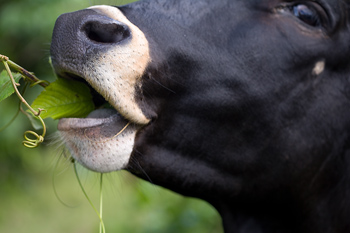
Grass fed beef will forage on many things and fill for cheap
If you were to raise only grass-fed beef, the probable strategy would be to geld the bulls into steers and release them back into the herd, once weaned. Take the heifers and sell them either as feeders or as yearling heifers for breeding by others. Means you’d be keeping half your progeny on your pastures.

Maturity is 20-22 months on average for grass-fed beef.

This approach has you birthing in April/May and selling yearling heifers off by June market highs. Grass-fattened cattle are ready the following year - either by auction at the June high, or (preferably) direct to the client.

Question is how much your crop land would generate in terms of pasture compared to farming it for corn and beans.

I've done the math on this, and raising crops is more profitable year-to-year on paper, even on our marginal land. However, you can't scale crops or add value readily - and if there's too much rain or not enough, you've got a crop failure and no income to pay those expenses off. And it's your time as well.

Meanwhile, the same land in grass would produce less or more, but it would still produce. Too many cattle for the grass and you weed out your worst stock, to sell at auction. But you still have a crop every single year. However, if you are able to direct-market your beef, you take out all the middlemen pricing as well. So you can get premiums for your beef this way - something you can't do with commodity grain.
And that is why we are moving more and more over to grass-fed beef and livestock in general. We can control the market better and get 4X the profit with much less work and inputs.

A story of profits

Let me tell you an actual scene I ran into. At this point, we were still selling our steers and heifers off as yearlings. We were making about $600 per head, still cutting and baling our own hay - which was really our only expense.

We went down to a farm tour where one of the presentations was on how they would fatten their cattle up locally and then ship them to Iowa for final finishing and were quite proud of making $60 profit per head.

Oops. We kept our mouth shut on that one - at least until we could get to the truck where no one could hear us.

So in mineral-rich Iowa, it might still make sense to fatten beef on corn, down in Missouri we will cry all the way to the bank that our land just doesn't produce enough corn to be able to afford anything but high-quality grass-fed beef sold to our own neighbors just the way they like it.

Enhanced by Zemanta